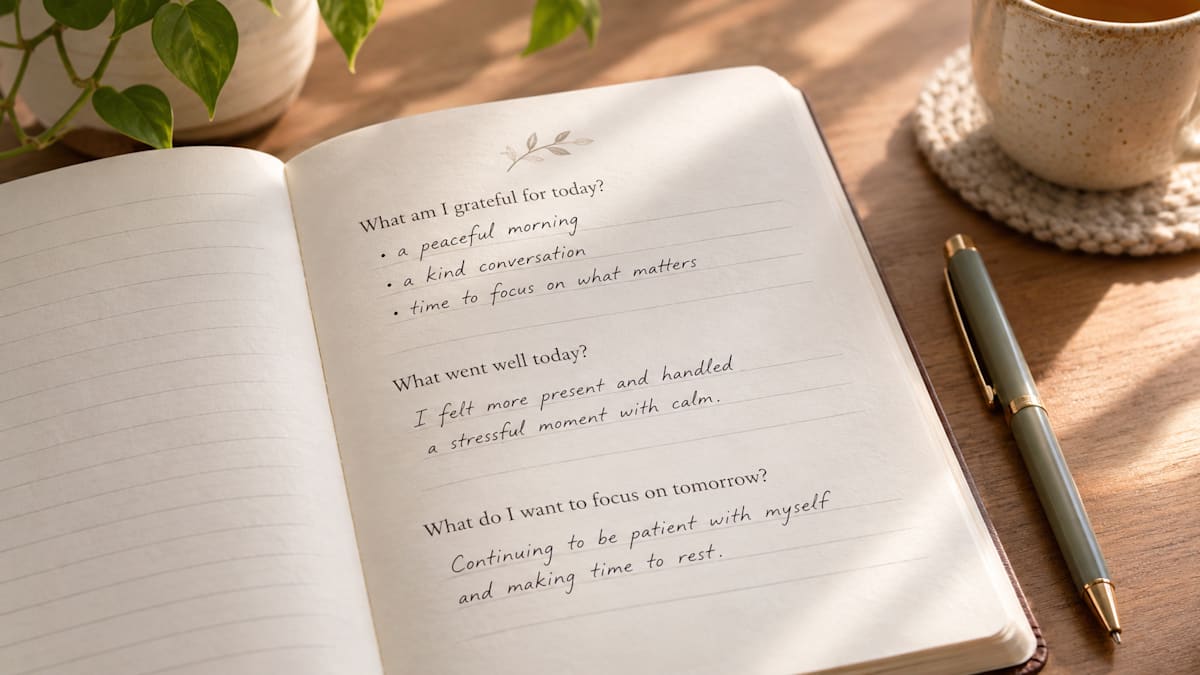
How writing changes the relationship between insight and action.
A reader can finish a thoughtful book and feel a genuine shift in perspective. The ideas are clear. The examples resonate. For a few days, the new understanding seems close at hand. Then daily routines return, familiar pressures appear, and the insight becomes something remembered rather than something practiced.
This gap is one reason guided journals and workbooks can be useful companions to nonfiction. Their purpose is not simply to make a book longer or give the reader homework. A well-designed prompt asks the reader to translate an idea into personal language, examine a real situation, and identify a next action that fits the life they actually live.
Consider the difference between reading “notice your automatic thoughts” and writing down a thought that appeared during a difficult conversation yesterday. The first is a useful principle. The second gives you something concrete to examine. You can ask what triggered it, whether it was accurate, and what response might have been more constructive. The page becomes a place for observation rather than self-judgment.
Writing also slows the pace. A sentence that seems obvious while reading may become surprisingly difficult when you try to apply it to your own choices. That difficulty is informative. Perhaps the idea needs more explanation. Perhaps the situation is more complicated than the example in the book. Perhaps you have discovered a conflict between what you value and what you habitually do.
Good prompts are specific without being controlling. “What does success mean to you?” can be useful, but it may be too broad to answer honestly in one sitting. “Describe one recent moment when you felt successful even though nobody else noticed” gives the mind a doorway. Concrete memories often reveal more than abstract declarations.
The format should invite return visits rather than demand a perfect streak. A reader may write three pages one day and only a few lines the next. Missing a week does not invalidate the process. A journal is a tool, not a test of discipline. Its value grows when the reader feels free to revise an answer, cross something out, or discover that an earlier conclusion no longer holds.
The Zen Power Mastery journals and companion materials are designed around this movement from recognition to practice. A reflection prompt can help identify a pattern. A guided exercise can suggest a new response. A later check-in can show whether the response was useful. None of those steps requires a dramatic transformation. Small, honest observations accumulate.
For readers who dislike journaling, the method can be adapted. Speak an answer into a voice note, discuss a question with a trusted friend, or jot a few words on a card. The important element is active engagement. You are taking an idea out of the author’s language and placing it in your own experience.
The next time you encounter a book with prompts or exercises, resist the urge to skip them automatically. Choose one that seems relevant and answer it without trying to sound wise. A blank page cannot do the work for you, but it can make room for a more useful conversation with yourself.
Explore more at https://daleallmanbooks.com.