Articles

The Thought That Sounds Like a Fact: Learning to Question Your Inner

A recurring thought can become familiar enough to feel authoritative, even when the evidence is incomplete.

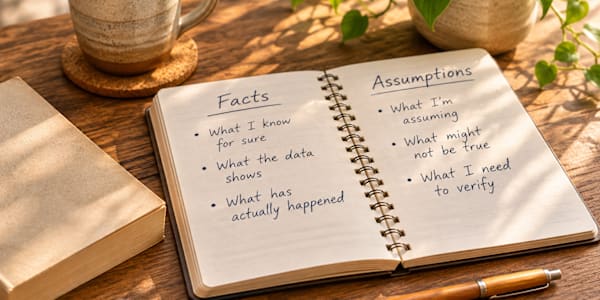
“I always ruin good opportunities.” “People like me never get ahead.” “If I slow down, everything will fall apart.” These sentences may arrive with the confidence of facts. Yet most are interpretations, not observations. They compress complicated experiences into sweeping judgments and then ask us to live as though the judgment has already been proved.

The distinction matters because...

Reading a Personal Growth Book Without Turning It into Homework How to take

How to take one useful idea off the page and into ordinary life

A book on mindset or self-care can leave you inspired and strangely burdened at the same time. There are exercises to try, habits to build, questions to answer, and perhaps a new version of yourself to become. By the final chapter, the list of possible improvements may be longer than the time you have available.

That is not the only way to read a personal growth book. You can approach it as a conversation rather than a curriculum....

A Reading Practice for People Who Never Finish Their Reading Lists The

The reading list grows faster than the reading habit. Someone recommends a book, an article promises a breakthrough, and another title joins the stack. Soon the list becomes a record of intentions rather than an invitation to read. The problem is not necessarily a lack of discipline. It may be that we have confused collecting possibilities with creating a practice.

Reading for growth does not require finishing a certain number of books each month. A single idea explored carefully may influence...

Why the Most Useful Chapter May Be the One You Disagree With We often open

We often open a personal-development book hoping to find language for something we already sense is true. When a passage confirms our experience, it feels clarifying. When it challenges a cherished explanation, we may feel an urge to dismiss it. Yet the page that irritates us can sometimes be the one that offers the greatest opportunity for reflection.

Disagreement is not proof that the author is right. Books can oversimplify, misread evidence, or mistake one person’s experience for a...

The Stories We Inherit About Success, and the Stories We Can Rewrite A

A reader’s reflection on the assumptions beneath ambition

Most of us inherit a definition of success before we have the experience to question it. We hear what a good career should look like, what financial security means, when important milestones should happen, and how a responsible adult ought to spend time. Some of these messages are helpful. Others become invisible rules we continue following long after our lives have changed.

The difficulty is that inherited stories rarely announce...

Why a Workbook Is Not Just a Book with Blank Pages How writing changes the

How writing changes the relationship between insight and action.

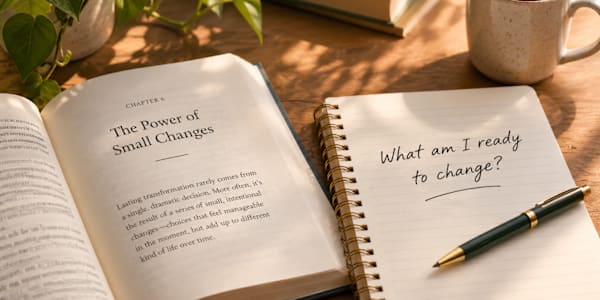
A reader can finish a thoughtful book and feel a genuine shift in perspective. The ideas are clear. The examples resonate. For a few days, the new understanding seems close at hand. Then daily routines return, familiar pressures appear, and the insight becomes something remembered rather than something practiced.

This gap is one reason guided journals and workbooks can be useful companions to nonfiction. Their purpose is not...

The Book You Need May Not Be the Book You Expected Why reading for change

Why reading for change begins with the question you are willing to ask.

We often choose books by the promise on the cover. We want more confidence, better habits, stronger relationships, or a clearer sense of purpose. The title names the destination, and we hope the pages will show us the route. But sometimes the most useful book is the one that interrupts the question we brought to it.

A reader looking for productivity advice may discover that the deeper issue is an inability to rest without...

You Can't Think Your Way Out of Every Problem. And That's the Problem. From

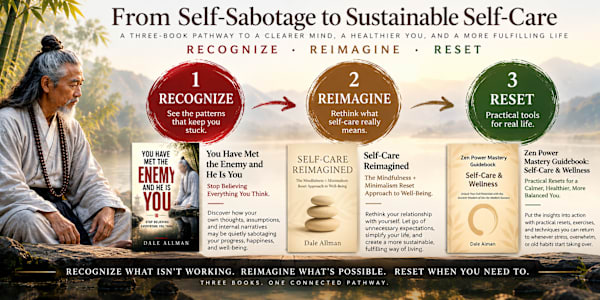
From Self-Sabotage to Sustainable Self-Care: A Three-Book Pathway to Recognize, Reimagine, and Reset

There is something remarkably frustrating about being human. We can recognize a bad habit, understand exactly why it's causing problems, promise ourselves we'll stop doing it, and then find ourselves doing precisely the same thing three days later.

Sometimes three hours later.

We know we need more rest, but we keep working. We know we should establish boundaries, but we say yes to another...

(Re-posted from my substack at daleallman.substack.com)

There comes a point when you realize that growth isn’t about adding more.

It’s about letting go.

More information. More pressure. More distractions. More noise.

The world tells us to do more, have more, become more.

But real power begins when you stop trying to push forward and start learning to pause.

This is where your reset begins.

The Reset Mindset

Resets aren’t about failure. They’re about alignment.

They’re the conscious choice to clear...

Introduction

In our modern world, stress has become an unwelcome constant. With demanding work schedules, endless digital notifications, and the pressure of balancing personal and professional lives, many are left searching for an effective way to escape and unwind. While traditional advice often recommends spending time in nature to reduce stress, this isn’t always feasible for everyone. Whether it’s due to geographic limitations, physical accessibility, or lack of free time, many people...

Latest review on OnlineBookClub.org is here: https://forums.onlinebookclub.org/viewtopic.php?f=24&t=565233


Nature Reimagined" by Dale Allman is a well-researched book that outlines the various benefits that can be harnessed by the use of virtual reality in the promotion of overall well-being. The author's wife became ill and had a stroke, which resulted in her limited mobility and reduced social interaction; later, she developed anxiety. The author embarked on thorough research on various...