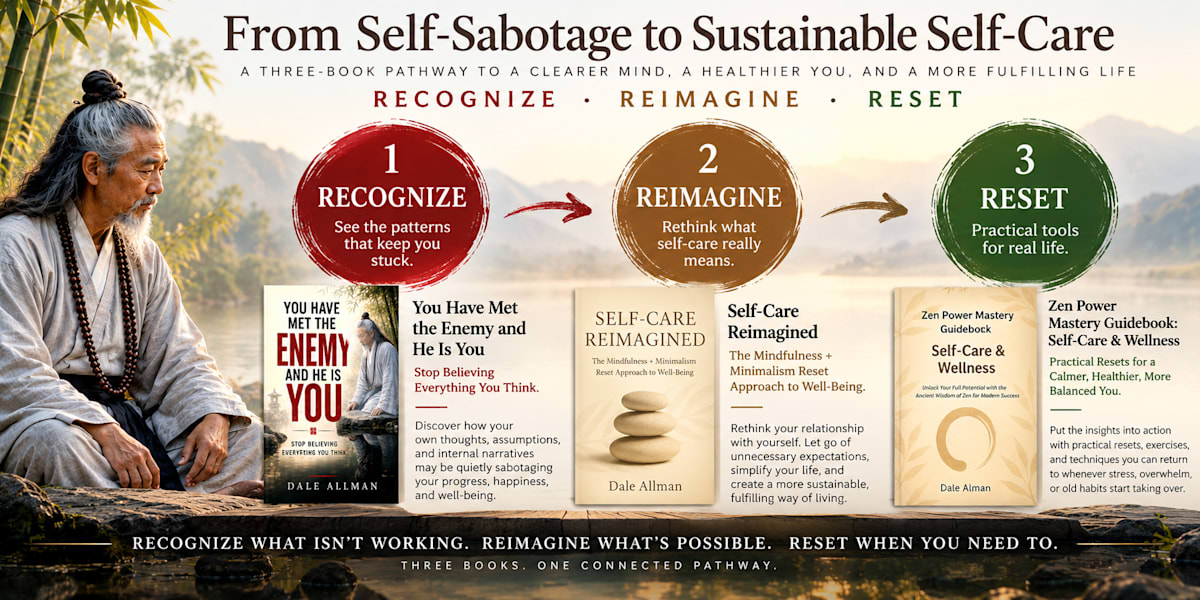
From Self-Sabotage to Sustainable Self-Care: A Three-Book Pathway to Recognize, Reimagine, and Reset
There is something remarkably frustrating about being human. We can recognize a bad habit, understand exactly why it's causing problems, promise ourselves we'll stop doing it, and then find ourselves doing precisely the same thing three days later.
Sometimes three hours later.
We know we need more rest, but we keep working. We know we should establish boundaries, but we say yes to another obligation. We know comparing ourselves to other people makes us miserable, but there we are, scrolling through social media and wondering why everyone else seems to have figured out life.
We understand the problem. We might even know the solution.
And yet, here we are again.
It's enough to make you wonder whether the biggest obstacle standing between you and a healthier, more satisfying life might occasionally be the person looking back at you in the mirror.
The good news? That person isn't your enemy.
But they might need a little help getting out of their own way.
The Patterns We Recognize but Keep Repeating
Consider a few familiar scenarios.
Have you ever stayed in a situation long after you knew it wasn't good for you because the discomfort of changing seemed worse than the discomfort of staying?
Have you ever talked yourself out of pursuing an opportunity because you decided, without consulting anyone else, that you probably weren't qualified?
Have you ever spent an entire day accomplishing things for other people, only to feel guilty because you hadn't accomplished enough for yourself?
Have you ever been exhausted, overwhelmed, and desperate for a break, but convinced yourself you hadn't earned one yet?
Have you ever replayed an embarrassing conversation from five years ago as though the entire world had been patiently waiting for the director's cut?
Or perhaps you've convinced yourself that once you lose the weight, earn the promotion, finish the project, pay off the debt, organize the garage, and finally get your life together, you'll be ready to enjoy it.
There's always one more condition, isn't there?
One more accomplishment. One more obligation. One more reason to postpone feeling satisfied.
And somehow, the finish line keeps moving.
These experiences aren't necessarily signs of weakness or personal failure. They're often reflections of beliefs, assumptions, expectations, and habits we've accumulated over years of living.
Some helped us succeed. Some helped us survive difficult circumstances. Others were never particularly useful in the first place.
But once these patterns become familiar, we tend to repeat them automatically.
Even when we know better.
Step One: Recognize What's Working Against You
You Have Met the Enemy and He Is You
The first step toward meaningful change is recognizing that not everything you think deserves to be believed.
Your mind is an extraordinary instrument, but it isn't always a reliable narrator.
It can turn uncertainty into catastrophe, interpret a minor setback as proof of inadequacy, and convince you that everyone else knows something you don't.
It can also tell you that being busy means being valuable, that asking for help means being weak, and that making a mistake means you've failed.
These stories often sound convincing because you've heard them so many times.
Eventually, familiarity begins masquerading as truth.
In You Have Met the Enemy and He Is You: Stop Believing Everything You Think, I explore the ways our internal narratives, expectations, and mental habits can quietly undermine our decisions, confidence, relationships, and happiness.
The purpose isn't to blame ourselves for everything that goes wrong. Life presents plenty of challenges that have nothing to do with our thinking.
The purpose is to distinguish between what's actually happening and the interpretation we're attaching to it.
Because recognizing a self-defeating pattern creates an opportunity.
You can question it.
You can challenge it.
And, perhaps most importantly, you can choose not to obey it.
Recognition doesn't solve every problem, but it gives you something enormously valuable: a choice you may not have realized you had.
Step Two: Reimagine What Taking Care of Yourself Means
Self-Care Reimagined
Once you begin recognizing the patterns that work against you, another question naturally follows.
What would life look like if you stopped treating your own well-being as an optional expense?
For many people, self-care has become another item on an already overwhelming to-do list.
Meditate. Exercise. Eat better. Sleep more. Be grateful. Practice mindfulness. Drink enough water. Maintain healthy relationships. Learn to relax.
Wonderful advice.
But when you're already exhausted, being handed twelve additional responsibilities doesn't necessarily feel like someone is taking care of you.
Sometimes it feels like more homework.
That's where we need to reconsider the entire concept.
Real self-care isn't about doing everything perfectly. It isn't about expensive retreats, elaborate morning routines, or becoming the sort of person who happily wakes up at 4:30 every morning to journal about their feelings.
If that works for you, terrific.
For the rest of us, perhaps there's another way.
In Self-Care Reimagined: The Mindfulness + Minimalism Reset Approach to Well-Being, I explore how mindfulness, simplicity, intentional choices, and healthier personal boundaries can help us create a more sustainable relationship with ourselves.
Instead of constantly adding more things to improve our lives, we can begin asking what needs to be removed.
What unnecessary expectations are we carrying?
What commitments no longer serve us?
What beliefs make rest feel irresponsible?
What would happen if we measured success partly by the quality of our lives rather than simply the quantity of our accomplishments?
Self-care becomes much more meaningful when it stops being another performance standard and starts becoming a way of living.
The goal isn't to become exceptionally good at managing exhaustion. It's to stop building a life that requires constant recovery from it.
Step Three: Reset When Life Happens
Zen Power Mastery Guidebook: Self-Care & Wellness
Now comes the practical part.
Because you can recognize your patterns, rethink your priorities, and develop a wonderfully enlightened philosophy about self-care.
And then Monday morning arrives.
The inbox is overflowing. Someone needs something immediately. A project goes sideways. Your carefully organized schedule collapses before your second cup of coffee.
Suddenly, all those healthy intentions are competing with the very real demands of everyday life.
This is where many self-improvement approaches fall short.
They explain what we should do but offer little help when we're overwhelmed, distracted, stressed, or sliding back into familiar habits.
What we need in those moments isn't another lecture about personal growth.
We need something we can actually use.
That's the purpose of Zen Power Mastery Guidebook: Self-Care & Wellness.
Drawing on Zen-inspired principles and practical self-care techniques, the guidebook focuses on approaches readers can return to whenever they need to interrupt an unhelpful pattern, regain perspective, or restore a sense of balance.
Think of a reset as a deliberate interruption.
A moment when you recognize that your thoughts, emotions, or circumstances are pulling you in an unhelpful direction, and you choose to respond differently.
Sometimes that means pausing before reacting.
Sometimes it means challenging an assumption, adjusting an expectation, simplifying a decision, or giving yourself permission to step away.
Not every situation requires a dramatic transformation.
Sometimes a small, intentional change in how you respond is enough to change what happens next.
And here's something I believe deserves more attention in conversations about personal growth:
You don't have to start over every time you slip back into an old habit.
You're allowed to have difficult days.
You're allowed to lose your patience, forget what you've learned, become overwhelmed, or discover that yesterday's brilliant insight didn't survive today's traffic.
Progress doesn't require perfection.
It requires a willingness to recognize what's happening and return to a more intentional response.
You don't need to start over.
You need a reset.
Three Books. One Connected Pathway.
Although these books were written as individual works, together they offer a practical progression for anyone seeking greater self-awareness, a healthier relationship with themselves, and more sustainable personal well-being.
RECOGNIZE: Identify the thoughts, assumptions, and familiar patterns that may be working against you.
REIMAGINE: Rethink what self-care, achievement, balance, and a satisfying life can look like.
RESET: Put those insights into practice with tools and intentional responses you can return to whenever life gets complicated.
You don't have to read them in any particular order. Each book stands on its own, addressing a different part of the journey.
But together they reflect a philosophy that has become increasingly important to me:
Personal growth isn't about fixing everything that's wrong with you.
It's about becoming more aware of what influences your choices, questioning the expectations you've accepted, and learning to respond to yourself and your circumstances with greater clarity and intention.
The most meaningful changes aren't always dramatic.
Sometimes they begin when you stop believing a thought that has been holding you back.
Sometimes they begin when you finally decide that your own well-being deserves a place on your calendar.
And sometimes they begin in the middle of an ordinary, frustrating Tuesday, when you notice an old pattern taking over and decide, just this once, to do something different.
That's not a small accomplishment.
That's how change begins.
Recognize what isn't working. Reimagine what's possible. Reset when you need to.
Three books. One connected pathway. And a different way to think about taking care of yourself.
Dale Allman
Author of You Have Met the Enemy and He Is You, Self-Care Reimagined, and the Zen Power Mastery Guidebooks.